Why AI Buyouts Will Eclipse Private Equity
Private equity defined the last era, AI buyouts will define the next

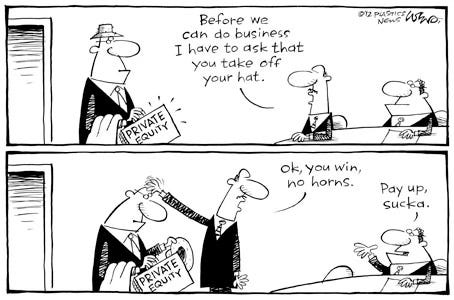
From the 1980s onward, private equity didn’t just become an asset class — it became the asset class. Today PE manages trillions — global private equity AUM is estimated at around $5.3 trillion as of 2023. In contrast, the entire US venture capital industry had roughly $1.21 trillion under management by end-2023. Venture’s footprint—though celebrated—has always been small relative to PE’s scale. PE bought grocery chains, nursing homes, logistics companies, whereas VC has been limited to bets on early-stage tech.
The PE playbook was simple: buy companies with cheap debt, cut costs, ride multiple expansion, flip for a higher price. And for decades, it worked—for the funds at least, if not for society.
Cheap debt and multiple expansion turned financial engineering into an art form, but it didn’t build better companies, in fact it often hollowed them out.
KKR and Bain’s buyout of Toys “R” Us ended in bankruptcy, wiping out 30,000 jobs. Payless and J.Crew—both PE-owned—suffered the same fate, crushed under debt loads too heavy to survive. Sears, once America’s everything store, was gutted. In healthcare, studies found death rates rose in nursing homes acquired by Cerberus and others as staff were slashed to prop up margins. In housing, Blackstone became the US’s largest landlord, hiking rents and evicting tenants while marketing itself as a “homes for families” company. Across industry after industry, private equity has meant higher prices, worse service, and a workforce squeezed to breaking point. Whatever efficiency gains existed never reached customers or employees—they were siphoned off to service debt and pad IRRs.
And when PE did try to reinvent companies, it mostly failed. “Digital transformation” under their watch was a buzzword exercise. Legacy retailers rolled out half-baked e-commerce sites years too late. Banks and insurers bought expensive IT systems they never fully implemented. Hospitals layered on clunky software that made doctors’ jobs harder, not easier. The consultants got paid, the software vendors got paid, but the companies didn’t get more productive. At best, PE-sponsored transformation was cosmetic. At worst, it distracted management while the real agenda—financial engineering—continued unchecked.
Today, the game has stalled. Debt is no longer free, multiples have compressed, and cost-cutting has been wrung dry. PE is left clutching a playbook that no longer scales.
Enter AI buyouts.
On a recent podcast, Marc Bargava at General Catalyst said he believed most service-based companies will ultimately be acquired by people initiating AI buyouts or rollups. And I think he’s right. The $16 trillion services economy—accounting, legal, IT, call centres, healthcare administration—has been off-limits to tech / venture because margins were too thin. Five to ten percent EBITDA doesn’t excite anyone. But AI is rewriting the math and opening up a truly vast area of interest for tech and VC to go after.
Marc’s team studied seventy service categories and found ten where 30–70% of tasks are already automatable today. That changes everything. A call centre, a bookkeeping firm, a managed IT provider—suddenly their 5–10% margins can look more like 30–40%. That’s not a story of cost-cutting but of transformation. Go after big players or roll-up small ones and suddenly you have venture-scale outcomes without the zero-to-one risk. If Marc’s right and we eventually acquire a large proportion of these companies, we will create an asset class significantly bigger than PE is today.
PE can’t win this game. Not because they won’t try—they’re already circling AI transformation—but because it isn’t in their DNA. Their model is financial first, operational second, and technological last. AI buyouts flip that order. They start with applied AI talent, layer in industry operators, then use acquisitions to accelerate distribution and proprietary data flywheels. That’s a fundamentally different sequence.
Tech people and VCs understand this intuitively. We know how to build products, ship fast, iterate with customers, and scale platforms. We can hire the PE operators where we need them. But the essence of this model—embedding AI into the core workflows of traditional businesses—is not something you can outsource to a McKinsey playbook or a debt model in Excel. It requires builder DNA.
And that’s why I believe the next era of acquisitions belongs to us, not them.
AI buyouts are not a tweak on the PE model, they’re a new asset class. Where PE optimized for financial engineering, AI buyouts optimize for margin expansion through technology. Where PE bought cash flows, AI buyouts buy workflows. Where PE cut heads, AI buyouts increase capacity.
The last era belonged to private equity, the next will belong to AI buyouts.